Your competitor dropped a shiny new feature last Tuesday. Big announcement. Bold claims. Zero proof.
And now your Slack is on fire. The CEO wants a "response." The sales team is forwarding the competitor's press release with "should we be worried?" subject lines. Your CMO is two meetings away from approving a campaign that basically says "us too, but better" — which is the most expensive way to say nothing.
I've watched this movie play out at probably 30+ companies. The ending is always the same: 6 weeks of panic, a pile of rushed content nobody reads, and zero measurable impact. (The competitor's feature, by the way, usually turns out to be half-baked and quietly sunset within 18 months. But I'm getting ahead of myself.)
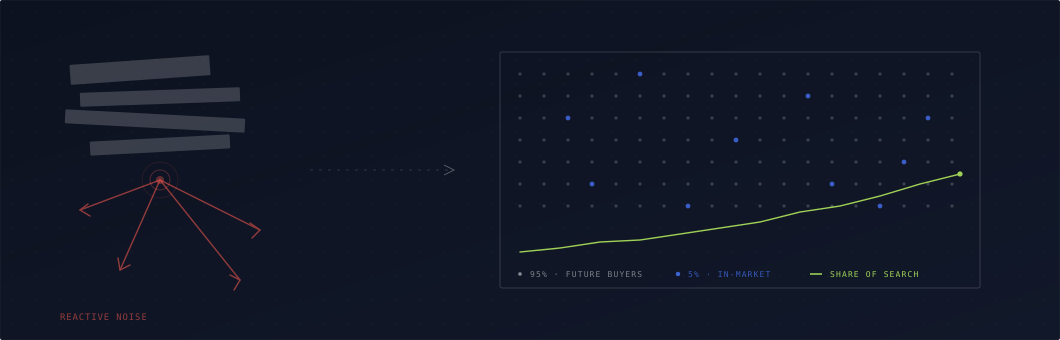
Real competitive strategy is not reactive. To win, you must stop chasing the competitor's news cycle and start investing where the 95% of your category actually lives.
Key takeaways
- Roughly 95% of your category isn't in-market at any given moment (Ehrenberg-Bass / LinkedIn B2B Institute). Reacting to a competitor launch fights over the 5% on their timeline.
- Start with exploratory research and real customer lists (Waterfall Logic) before you spend a dollar testing hypotheses.
- A 10% improvement in price yields ~25% more profit (Marn & Rosiello, HBR 1992). Fight on price math, not feature matrices.
- Share of Search correlates with future market share at ~83% and leads sales by months — use it to measure whether the launch is real.
What is the 95:5 rule?
The 95:5 rule is a model developed by John Dawes at the Ehrenberg-Bass Institute — later amplified by Peter Weinberg and Jon Lombardo at the LinkedIn B2B Institute — which states that at any given moment, approximately 95% of a B2B category is not in-market. They're not actively shopping, comparing, or buying. Only ~5% are in-market and ready to purchase in the next quarter. The strategic implication: optimising purely for the 5% who are buying today leaves you fighting competitors on their news cycle; building distinctive memory structures with the 95% compounds into future market share.
In this article we also define: Share of Search · Category Entry Points · Permissionless Value Prop · Won Sales Analysis.
No. 01 Most competitive responses are expensive emotional reactions
Let me describe what happens in 90% of companies when a competitor makes noise.
The marketing team drops everything. They build comparison charts nobody asked for. They write blog posts defending capabilities they already had. They rush a webinar to "address the market." The whole machine shifts from building long-term brand equity to fighting over the 5% of buyers who happen to be shopping right now.
John Dawes at the Ehrenberg-Bass Institute — later amplified by Peter Weinberg and Jon Lombardo at the LinkedIn B2B Institute — built the model around this. At any given moment, roughly 95% of your category isn't buying. They're not in-market. They're not comparing. They're not reading your comparison chart.
That 5% who ARE in-market? Your competitor is fighting you for them with a fresh press release and a full sales blitz. And you want to out-shout them on their news cycle? Good luck. You're playing their game on their timeline.
The move is counterintuitive: ignore the 5% battle. Win the 95%. (I know that sounds insane when your CEO is asking "what are we doing about this?" But stick with me — the math is on your side.)
| Dimension | Reactive response | 95:5 playbook |
|---|---|---|
| Target audience | 5% in-market this quarter | 95% not buying yet — future demand |
| Time horizon | Weeks (competitor's news cycle) | Quarters to years (memory structures) |
| Leading indicator | Form fills, webinar attendance | Share of Search (~83% correlation with future market share) |
| Primary asset | Feature comparison chart | Price-math model + causal trigger list |
| Cost profile | High short-term burn, zero compounding | Lower marginal cost, compounds over time |
| Measured outcome | Short-lived pipeline blip | Category Entry Point capture + durable win rate |
No. 02 Figure out what you don't know before you pretend you do
Here's what I see teams do wrong immediately. A competitor launches something, and the first instinct is to run explanatory research — surveys, focus groups, A/B tests — trying to prove your product is better.
That's backwards.
You haven't even figured out what questions to ask yet. If you skip straight to testing, you're spending real money validating the wrong assumptions. When you're entering unknown territory, you start with exploratory research to generate hypotheses — not explanatory research to test them. The cost of skipping this step isn't just wasted budget — it's building your entire competitive response around a variable that doesn't matter.
Don't build "Marketing Mary." Build real customer lists. Query your data providers in sequence — first-party data, then enrichment tools, then AI agents scraping public signals — until you hit 80%+ coverage of real humans at real companies. You're looking for specific people who use the competitor's legacy stack AND recently posted a hiring signal that indicates dissatisfaction. Real names. Real companies. Real timing.
This is the Waterfall Logic approach. It sounds like more work upfront. It is. It also means every dollar you spend after this point hits an actual person instead of a demographic ghost.
No. 03 Stop fighting feature wars. Fight on price math.
Every team's first instinct in a competitive crisis is to compare features. Feature checklist. Feature matrix. "We have 47 features, they have 39." Nobody cares.
The pricing research — specifically the work Michael Marn and Robert Rosiello published in Harvard Business Review in 1992 — shows the numbers are wild. For a typical company, a 10% improvement in price yields a 25% increase in profit. A 10% increase in volume? Only 10% more profit. Price is the only part of the marketing mix that generates revenue. Everything else — every ad, every event, every piece of content — generates costs.
Instead of a comparison chart, calculate the actual financial difference between your solution and the competitor's specific offering. In dollars. The annual economic benefit of switching — revenue gained, costs saved, risk reduced — minus the switching costs. Training time, downtime, integration headaches, and the political cost of the VP who approved the old tool having to admit they were wrong. (That last one is real and almost never quantified.)
If your solution saves $25,000 a year in labor costs compared to theirs, the sales conversation stops being "our feature is better than their feature" and becomes "your payback period is 4.7 months." That's math. Math doesn't care about press releases.
Hope that logic works as cleanly in practice as it does on paper — in my experience it gets messy about 60% of the time because prospects don't always do the rational thing. But even a clumsy version of this beats a feature comparison every single time.
No. 04 Seed the 95% and track it with Share of Search
Back to the 95:5 problem.
While your competitor burns budget chasing the 5% of in-market buyers with their launch campaign, you should be doing something completely different: building memory structures with the 95% who aren't buying yet.
What is Share of Search and why is it a leading indicator?
Share of Search (SOS) is the proportion of total category search volume captured by a given brand — measured by tracking how often people Google your brand name vs. each competitor. Les Binet — the godfather of marketing effectiveness research — presented data showing that Share of Search has an ~83% correlation with future market share. And the kicker: SOS shifts show up months before sales numbers move. It's a leading indicator, not a lagging one.
Monitor Share of Search weekly. If the competitor's SOS jumps for 2 weeks then drops back, the launch was noise. If it keeps climbing, it's building real brand momentum and you need to adjust. Binet and Field's The Long and the Short of It (2013) suggests 60% brand / 40% activation for B2C; the LinkedIn B2B Institute adjusted this to roughly 46% brand / 54% activation for B2B. Most B2B companies are spending close to 0% on brand and 100% on activation.
What does "seeding the 95%" look like? Jenni Romaniuk at the Ehrenberg-Bass Institute built the framework: Category Entry Points. The specific situations where someone thinks "I need a solution." A new VP inherits a mess. The board meeting reveals a compliance gap. A failed audit. You want your brand linked to those moments in people's heads so that when the trigger happens — 6 months from now, 2 years from now — you're already the name they think of.
This is genuinely the hardest thing to sell to a panicking CMO. "I know the competitor just launched something, but let's invest in being remembered 18 months from now." It sounds like doing nothing. It's actually the highest-ROI move available.
No. 05 Stop gating your best stuff. Donate value instead.
The standard B2B playbook says: write an eBook, put it behind a form, collect emails, nurture them to death.
That playbook is dying. And using it as your competitive response is even worse.
Borrowed from outbound sales, not marketing. Find a specific, provable problem your prospect has, fix a piece of it for free, and send it to them without asking for anything.
For example: you find e-commerce sites with a Google PageSpeed score below 30. (Public data — anyone can check it.) You identify the specific image files causing the lag. You compress them. You send the prospect the optimized files with a note that says "These 4 images are adding 3.2 seconds to your load time. Here they are, fixed. No strings."
That's not marketing. That's proof of competence delivered without permission.
The zero-click version works on LinkedIn and X: instead of posting a teaser and driving people to a landing page, deliver the full insight inside the feed. No click required. No gate. No form. The person gets the value right there.
Will this "convert" immediately? Probably not. But when the trigger event happens — new budget cycle, executive change, a competitor failing them — the brand that educated them for free beats the brand that tried to lure them off-platform with a PDF.
No. 06 Find the actual cause, not just the correlation
This is where most competitive analysis falls apart completely.
Why do correlations from win/loss data mislead teams?
Teams look at win/loss data and see patterns. "We win when the prospect has 500+ employees." "We lose when IT is involved in the decision." Those are correlations. They're cheap to find and nearly useless for making decisions — because the causation isn't clear. Maybe you win at 500+ employees because your pricing tiers happen to make sense at that size. Maybe you lose when IT is involved because your security docs are outdated. The correlation doesn't tell you.
What is IRI BehaviorScan and why does it matter?
IRI developed a method called BehaviorScan back in the 1980s — they'd literally split TV cable signals in test markets to serve different ads to different households, then track purchasing through store scanner data. It's one of the few methods that moved marketing measurement from "these things seem related" to "this caused that." Most teams don't have access to anything that rigorous. But the principle applies everywhere — which is what a Competitive Proof Sprint is built around.
What is Won Sales Analysis?
Won Sales Analysis is a post-close interview method that asks one question of recent closed-won customers — "What happened in your business the day before you started looking for a solution like ours?" — to surface the causal event that triggered the purchase decision, rather than the surface-level reason people self-report for choosing a vendor.
Call your last 20 closed deals and ask one question: "What happened in your business the day before you started looking for a solution like ours?" Not "why did you choose us." Not "what features mattered." What was the actual event that caused you to move?
You'll find patterns. An executive hire. A failed audit. A competitor's price increase. A board meeting that went sideways. These are your real triggers — and they have nothing to do with your competitor's new feature.
If you build your GTM engine around these causal triggers instead of around reacting to competitor announcements, you stop playing defense permanently.
The thing nobody wants to hear
I want to be honest about something. I've laid out a 5-step framework here and it sounds clean on paper. In practice, it's messy. The exploratory research takes longer than you want. The price math requires data your finance team doesn't want to share. The brand investment feels invisible for months. The Permissionless Value Prop requires effort that doesn't show up in your MQL dashboard.
Most teams will read this, nod, and then go build a comparison chart anyway. Because comparison charts feel productive. They're visible. They're fast. And they're completely useless against a competitor who's building brand equity with the 95% while you fight over scraps.
The real question — and I mean this as an honest diagnostic, not a flex — is whether your competitive response is grounded in something you can actually measure and prove, or whether it's just an emotional reaction dressed up in a slide deck.
Because if you can't name the causal trigger that drives your best deals, and you can't quantify the dollar difference between you and the alternative, you're not running a competitive strategy. You're gambling. With someone else's money.
Sources & further reading
- Dawes, J. Advertising Effectiveness and the 95-5 Rule: Most B2B Buyers Are Not In-Market Right Now. LinkedIn B2B Institute / Ehrenberg-Bass Institute.
- Marn, M. V., & Rosiello, R. L. (1992). Managing Price, Gaining Profit. Harvard Business Review.
- Binet, L., & Field, P. (2013). The Long and the Short of It: Balancing Short and Long-Term Marketing Strategies. Institute of Practitioners in Advertising (IPA).
- Romaniuk, J. Building Distinctive Brand Assets and work on Category Entry Points. Ehrenberg-Bass Institute.
- IRI BehaviorScan single-source testing methodology (1980s).