The difference between companies that win and those that guess comes down to one thing: understanding the competitive landscape with clarity, not assumptions. Most teams treat competitive analysis as a one-time project — a spreadsheet built before a board meeting, then forgotten. That approach leaves money on the table and deals on the floor.
Competitive analysis isn't about obsessing over rivals. It's about understanding the battlefield so you can make smarter moves.
Key takeaways
- Competitive analysis treated as a one-time project leaves deals on the floor — it must be a living, quarterly process.
- Analyzing strategy (economies of scale, customer captivity) beats tracking features, which are imitated within months.
- Tie every finding to a deployable action for sales, marketing, or product — analysis that stays on a shelf is worthless.
No. 01 Why competitive analysis matters
Good competitive analysis helps you spot market gaps before competitors do. It reveals why customers choose them instead of you. It prevents analysis paralysis by focusing only on what matters. And it gives your business development teams the insights to outsmart, not outspend, your competition.
No. 02 Define your scope first
One of the biggest mistakes is trying to analyze everyone and everything. Instead, set boundaries.
Focus on four competitor categories: Direct competitors who offer similar products to your audience. Indirect competitors who solve the same problem in different ways. Aspirational competitors — companies you admire or fear could enter your space. And emerging competitors — new players who could disrupt.
Ask yourself: what business decision am I trying to make with this analysis? This keeps your research focused and prevents the infinite scope problem from draining your resources.
No. 03 Collect the right data
There are three layers to good research.
Customer interviews — why they chose X over Y. Sales team insights from won and lost deals. Mystery shopping competitors' products.
Secondary research fills in the broader picture: Competitor websites, press releases, and product pages. Financial reports and investor presentations. Social media monitoring and online reviews.
Facebook Ad Library to see every ad a competitor runs. LinkedIn Ads Tab to check their B2B campaigns. SEMrush or SimilarWeb to uncover traffic, keywords, and ad spend. The Wayback Machine to track changes in their messaging over time.
No. 04 Analyze strategy, not just features
Great competitive analysis goes beyond "they have this feature, we don't." Focus on why they win and how they keep customers.
- Economies of Scale — Do they win because they're cheaper at scale?
- Customer Captivity — Do contracts, integrations, or habits make switching costly?
- Positioning — How do they want to be seen? Premium? Budget? Innovative?
- Assumptions — What are they getting wrong about the market that you can exploit?
No. 05 Compare tactics side by side
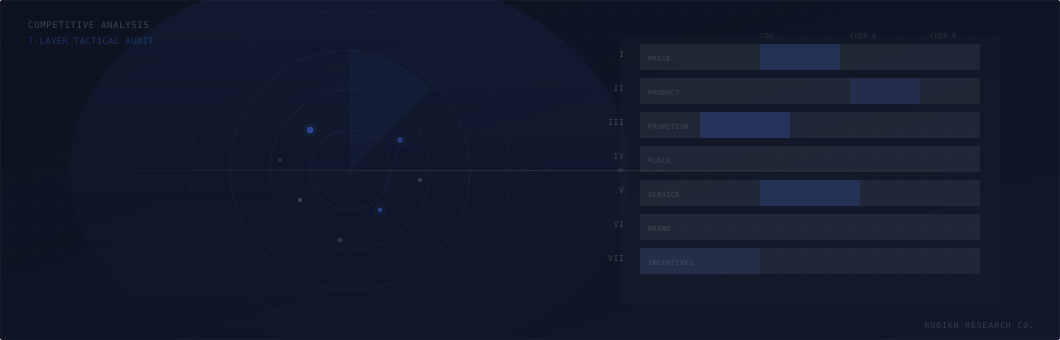
Break down the seven tactical levers competitors use to fight in the market.
- Price — Discounts, subscriptions, free trials.
- Product — Features, quality, innovation.
- Promotion — Ads, PR, content marketing.
- Place — Channels, partners, markets.
- Service — Support, warranties, onboarding.
- Brand — Trust, reputation, customer perception.
- Incentives — Loyalty programs, bundles, bonuses.
Use a comparison table so differences pop out immediately. Weight each lever by customer value — not every tactic deserves equal attention.
No. 06 Turn insights into action
Analysis is useless unless it drives action. After your research, always answer:
- Where is there a gap we can exploit?
- Which competitor weaknesses can we attack?
- Which strengths of ours should we double down on?
- What should we stop worrying about?
Tie findings to clear recommendations for sales, marketing, or product teams. A good analysis produces deployable assets, not shelf-ware.
No. 07 Keep it simple and updated
A good competitive analysis isn't 100 pages long. It's a one-page summary per competitor plus a matrix for comparison. Keep it living and breathing — update it quarterly with fresh insights.
Competitive analysis isn't about obsessing over rivals. It's about understanding the battlefield so you can make smarter moves. The goal isn't to copy them — it's to beat them where it counts.