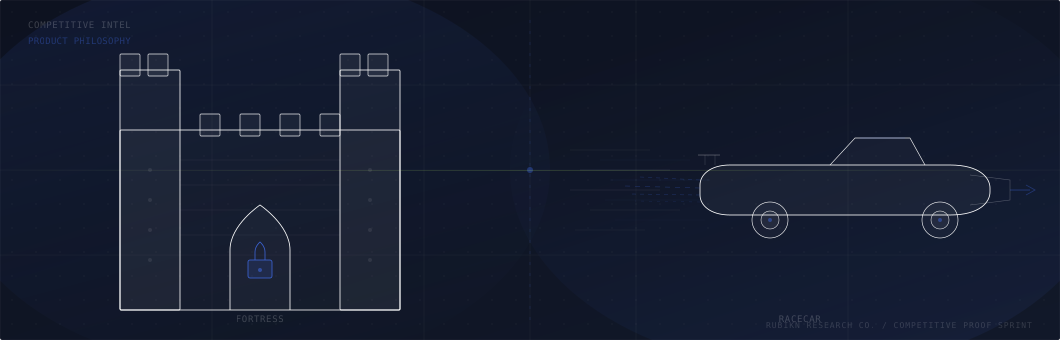
While software tools like Jira and Linear appear to be direct competitors, a deeper look reveals they are playing entirely different games. This isn't just a battle over features; it's a fundamental conflict between two opposing product philosophies — enterprise control versus developer flow.
This article explores the most surprising takeaways from their divergent strategies and what it means for the future of how teams work.
This isn't a feature war. It's a philosophy war — and the winner will be decided by whose worldview the modern developer chooses to live inside.
Key takeaways
- Jira's moat is lock-in (you can't leave); Linear's is love (you don't want to) — these require completely different counter-strategies.
- Developer frustration with Jira is emotional, not rational — a leading indicator of churn as soon as switching costs drop.
- When the user and the buyer hate the same tool, "rot from the bottom" via shadow adoption is an inevitable competitive opening.
No. 01 The "developer revolt" against Jira is real and emotional
Beyond typical software gripes, a significant segment of technical users expresses deep, emotional frustration with Jira — the human cost of a product philosophy centered on control over usability. Analysis of recent user reviews shows a notable minority (~10%) expressing vehement dissatisfaction with emotional and charged language. This growing "developer revolt" is fueled by years of accumulated pain points.
The key complaints center on overwhelming complexity ("bloat"), a counterintuitive user experience, and poor performance. The hatred is not about missing features; it's about the daily experience — "friction. Glacial UI, endless clicks, zero joy."
User sentiment like "It is like Windows — everybody hates it, but everybody uses it" and "I've been a Jira admin almost all my career, and I cannot take it anymore" reveals a structural vulnerability. Emotional frustration is a leading indicator of churn when switching costs drop.
No. 02 Two different "operating systems": control vs. flow
The strategic split comes down to a fundamental difference in product philosophy. Each is building a distinct "operating system" for work.
Jira: Engineered as a Comprehensive Governance Platform. Prioritizes features solving the "anxiety of scale" for enterprise administrators — Audit Log Query Language (ALQL), robust security, granular permissions. A "forensic tool" for answering "who did what, and when."
Linear: A High-Performance Execution Engine. Solves the "anxiety of friction" for developers. Local-first architecture using IndexedDB delivers "sub-100ms" interactions. Keyboard-first UI designed to accelerate actions and preserve "flow state."
This core difference is deeply felt: "Using Jira feels like trying to do work through a permission system." When analyzing competitive positioning, map the product philosophy — not just the feature set.
No. 03 Jira's moat is lock-in; Linear's is the "cult of speed"
Jira's moat is built on High Switching Costs — "Ecosystem Entanglement" through bundled products and unified platform-level objects. The "cost of change exceeds the pain of staying."
Linear's moat is built on Habit Formation — speed and keyboard-first workflow creates "Cognitive Muscle Memory." After becoming proficient, developers feel physically slower on any other tool.
Jira relies on Lock-in (you can't leave). Linear relies on Love (you don't want to leave). In competitive intelligence, these two moat types require completely different counter-strategies.
No. 04 Their marketing tells you exactly who they serve
Jira's marketing targets enterprise decision-makers. Keywords: SCALE, COMPLIANCE, AI DRIVEN, SECURITY. Top-down promise of control.
Linear speaks directly to developers with a rebellious tone against "bloated tools." Keywords: CRAFT, MOMENTUM, SWITCH, ENJOY. Bottom-up appeal to flow.
This creates a massive "Sentiment Gap" — Jira Reality: "Resignation." Linear Reality: "Dopamine."
When messaging keywords diverge this sharply from user sentiment, you have a structural positioning vulnerability. Jira keywords: BLOATED, SLOW, NIGHTMARE. Linear keywords: FAST, JOY, FLOW, LOVE. The gap between brand promise and user reality is where competitors attack.
No. 05 Jira wins the buyer, Linear wins the user — and that's a problem
Jira's strategy is vulnerable to the "Manager Fallacy" — assuming the ultimate value for the buyer is "Control." But effective control depends on data quality. If developers hate the tool, they stop updating it. Creates a "Usage Gap" where developers "only bulk-update Jira once a week."
This opens the door for "The Rot from the Bottom." Frustrated teams use "Shadow Linear" on credit cards. Bottom-up adoption can eventually force enterprise contract switches.
"Linear is the first tool where I actually keep tickets up to date. In Jira I just do the minimum so management stops asking." When the CIO has "Administrative Control" over an empty, inaccurate database, the fortress becomes a liability.
In the future of work, which will prove more valuable: the system that guarantees control, or the one that unleashes flow?