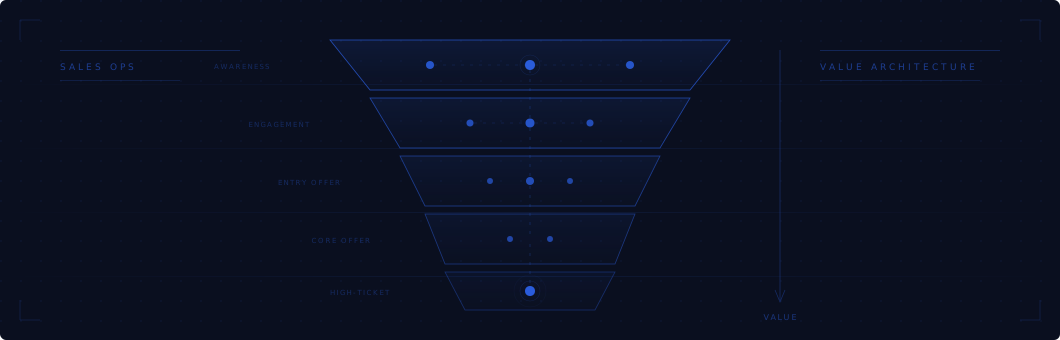
A smart sales funnel requires understanding exactly who you help. Generic campaigns often miss the mark because they fail to speak directly to your audience. The modern funnel is not a sequence of "nurture emails" — it is an engineered path where every stage delivers specific proof.
Effective sales funnels emphasize connection and growth. The fundamental principle: every step of your funnel should serve the client's goals.
Every step of your funnel should serve the client's goals. Not yours — theirs.
Key takeaways
- Generic campaigns fail because they don't speak to buyer personas built from actual purchase-authority data.
- Email delivers $42 for every $1 spent — channel selection, not creative, is the highest-leverage funnel decision.
- A Value Ladder captures revenue from all market segments while guiding customers toward deeper, higher-value engagement.
No. 01 Define your ideal client
Build detailed buyer personas including basic info (industry, job title, company size, location), goals and aspirations, challenges and pain points, buying triggers and objections, and where they gather information.
Research should be data-driven through customer interviews, surveys, and CRM analysis. Well-crafted buyer personas guide content creation — personalized strategies built around personas consistently outperform one-size-fits-all approaches.
Create at least one detailed persona with a name, noting their frustrations, reading habits, and definition of success. If a data point does not correlate with purchase authority or value extraction, it's noise.
No. 02 Find and engage your audience
Reach prospects where they already spend time.
- Industry Platforms. LinkedIn — 44% of B2B marketers rate it as the most important social channel; 40% say it's most effective for quality leads.
- Online Communities. Forums, Facebook Groups, Slack channels, subreddits.
- Content Hubs. Guest posts on relevant blogs, podcasts, YouTube channels.
- Email and SEO. Email delivers $42 back for every $1 spent. SEO captures customers actively searching for solutions.
Firms using clear audience segmentation achieve 77% of their marketing ROI from targeted campaigns. Targeted marketing dramatically outperforms broad outreach.
No. 03 Create value-based entry points
Entry-point offers (lead magnets or tripwires) solve problems without hard selling.
- Free High-Value Content. Ebooks, whitepapers, guides, checklists, templates addressing specific pain points.
- Free Trials or Samples. Let prospects experience core benefits risk-free.
- Introductory Offers (Tripwires). Low-cost paid offerings ($5–$29) that signal commitment.
- Interactive Tools. Calculators, assessments, quizzes.
- Events and Workshops. Free webinars or live training sessions.
50% of marketers experience higher conversion rates when using lead magnets. Entry offers must be genuinely helpful, solving real problems immediately.
Use email automation to deliver content sequentially, combining free and low-cost offers, and A/B test to identify which magnets attract your ideal clients.
No. 04 Envision and deliver transformational results
Focus on customer outcomes rather than features.
- Speak in customer language. Use testimonials highlighting actual results.
- Focus on outcomes, not features. Connect technical specs to customer goals.
- Set measurable goals. Define KPIs customers can track (revenue growth, productivity gains).
- Use stories and narratives. Share client journey narratives showing why solutions matter.
Position your funnel as "the path from Problem to Success." Buyers are emotionally driven by what's at stake. Authenticity matters — overpromising erodes trust.
No. 05 Build a value ladder for lasting growth
The Value Ladder structures offerings at increasing value and price levels.
- Entry/Intro Level. Free or very low-cost offering (free trial, ebook, $7 miniguide).
- Core Offer. Primary solution (subscription, foundational course, standard consulting).
- Profit Maximizer (Upsell). Advanced or comprehensive version (premium plan, group coaching).
- High-Ticket/High-End Offer. Top-tier offering (one-on-one coaching, enterprise license, mastermind retreat).
Key principle — "Always provide more help than the price increases." Each step must represent clear value upgrades, not arbitrary price jumps.
The ladder captures value from all market segments while guiding customers toward deeper engagement. B2B example: Freemium → Basic ($49/mo) → Professional ($199/mo) → Enterprise ($5,000+/mo).
Every step of your funnel should serve the client's goals. Customer feedback continuously refines personas, channels, offers, and ladder structure.