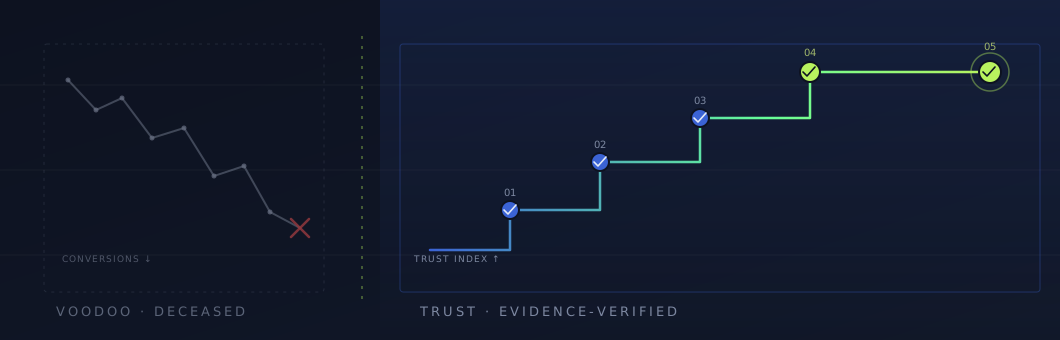
Modern B2B marketing is stuck on a Performance Plateau. The symptoms show up in the deck every quarter: declining conversion rates, rising acquisition cost, slipping pricing power. The creative didn’t get worse. The market got more skeptical.
The root cause is the divorce between brand work (which chases long-term equity) and performance work (which obsesses over short-term attribution). When the two are unaligned, the gap is filled with what we call voodoo marketing — intuition, generic platitudes, and unvalidated claims. The output is forgettable at best and corrosive at worst.
The fix is not louder positioning. It is a different operating model: GTM Engineering. The GTM engineer doesn’t run more campaigns; they architect systems that treat the market as a dataset to be queried, enriched, and engaged with mathematical proof, psychological agency, and temporal precision. Trust becomes a measurable output, not a marketing aspiration.
Random acts of marketing produce random results. Trust is engineered, not asserted.
Key takeaways
- Replace ultimatum CTAs with a menu of options. Agency is the smallest unit of trust.
- Quantify value against the Next Best Alternative. Math is more credible than adjectives.
- Run continuous Exploratory Market Research. Assumptions decay; Reebok is what happens when EMR stops.
- Rent trust through influencer and audience credibility — not through commodity data lists that rot in weeks.
- Hunt the Window of Dissatisfaction; first-call effectiveness compounds the 74% win-rate uplift.
What is voodoo marketing — and what replaces it?
Voodoo marketing is any decision made with intuition where evidence was available. The campaign brief that says “modern and approachable” instead of a measured WTP. The persona document built from a stock-photo face instead of a verified account list. The annual planning meeting that argues for a 90/10 activation split because last year felt “okay.”
GTM Engineering is the operating model that replaces each of those moments with an evidence trail — a verified profile, an audited price, a declared intent signal, an observed trigger. The five shifts below rebuild trust at each of those moments.
In this article we also define: the Menu of Options as a trust-builder · Differential Value vs. the NBA · the Hierarchy of Advertising Effectiveness Metrics · Renting Trust & the Post-Data-Provider Paradigm · First-Call Effectiveness.
No. 01 Agency over ultimatums
Conversion orthodoxy insists on a single CTA — usually “Request a Demo” — on the theory that more options cause “analysis paralysis.” In a high-consideration B2B context this is a trust killer. A single CTA forces a binary: click the high-friction button or bounce. Every researcher who is not yet sales-ready is discarded, and the page tells them, structurally, that you would rather have nothing than a low-commitment relationship.
The Menu of Options framework inverts the ultimatum. Offer two to four CTAs at different depths of intent and let the visitor choose. The behavioral mechanism is agency and control: when a buyer picks between A and B, they feel ownership of the decision, and that ownership is the smallest unit of trust you can build before a salesperson is involved.
- The self-serve persona. “Start free trial” lets the technical evaluator explore independently. No human friction; no sales pressure.
- The high-touch persona. “Talk to an expert” or “Request a demo” serves the late-stage decision-maker who needs to validate fit with a human.
- The early-stage researcher. “Watch a 2-minute tour” or “View a sample report” captures the micro-yes from a learner who would have bounced from a demo request.
Each declared path becomes attribution and routing data the moment it’s clicked. Marketing knows who arrived as a learner; Sales knows who arrived as a buyer; the trust starts on the page, before either function gets involved.
No. 02 The math of trust
Skepticism does not bend to adjectives. “Industry-leading.” “Modern.” “Best-in-class.” Every competitor uses the same words; the words have no information content; the buyer’s pattern recognition flags them as noise. Credibility comes back the moment the conversation moves to quantified economic outcomes.
Value is never absolute in B2B. It is calculated relative to the Next Best Alternative — the competitor or the status quo. The number the buyer cares about is the net incremental benefit: your annualized economic benefit minus the NBA’s, then minus the total cost of ownership including switching, training, and downtime.
An energy-efficient industrial-lighting vendor against the incumbent:
1. Annualized client benefit: $10,000 / year in energy saved.
2. NBA benefit: $8,000 / year.
3. Differential value: $2,000 / year incremental.
4. Switching cost (install + downtime): $5,000.
5. Payback period: 2.5 years.
The CFO no longer compares brochures. They compare a 2.5-year payback against the cost of doing nothing — in a language the buying committee can audit.
If you cannot quantify your value against the next best alternative, you do not have a credible offer. You have a brochure.
No. 03 Continuous EMR is the foundation of credibility
Most marketing teams over-invest in explanatory research — A/B tests, attribution dashboards, post-hoc lift studies — and under-invest in Exploratory Market Research (EMR), the investigative methodology that defines ambiguous problems and generates the hypotheses that justify spending money in the first place. Without continuous EMR, you optimize the wrong things very precisely.
Gatorade’s classic discipline was to pilot regional vs. national campaign appeal before a full rollout. The cost was a small regional test; the saving was the cost of a national campaign that would have missed. The corollary is the cautionary case of Reebok in the 1980s. The brand had ridden an EMR insight that athletic shoes were being adopted for casual “picnicking” wear. The insight worked — until the market shifted toward “brown shoes” for casual occasions and Reebok’s EMR had gone stale. The decay rate of exploratory findings is faster than most marketing teams want to admit. The fix is to keep running EMR continuously, not as a once-a-year offsite exercise.
The output of disciplined EMR is a verifiable trust ladder. Different metrics carry different weight, and the highest-credibility metrics are the ones closest to actual purchase behavior.
| Tier | What it measures | Representative method |
|---|---|---|
| Cognitive / attention | Real-time engagement at the neural and visual level. | EEG, fMRI, eye-tracking. |
| Awareness / retrieval | Whether the brand surfaces when prompted. | Top-of-Mind Awareness (TOMA), aided / unaided recall. |
| Attitudinal | How the brand feels relative to the category. | Numerical sentiment scales, brand-feeling surveys. |
| Behavioral intent | Stated purchase likelihood and price tolerance. | Willingness-to-pay studies, conjoint analysis. |
| Observed behavior | Causal link between exposure and actual purchase. | BehaviorScan single-source measurement (IRI Worldwide). |
The further down this ladder you push your evidence, the harder your claims are to dismiss. BehaviorScan-grade causal validation is overkill for a single landing page; for category-level positioning claims that anchor your pricing power, it is the difference between an asset and an assertion.
No. 04 Permissionless value — and renting trust
The gated eBook is a depreciating asset. Buyers are fatigued by generic PDFs hidden behind forms, and the form itself is friction that filters out exactly the researchers you want.
The replacement is the Permissionless Value Prop: a customized, valuable asset delivered outbound, unrequested, valuable enough that the recipient would have paid for it. A specific audit. A diagnostic that names the prospect’s actual gap. The Rubikn-style version sends a fix — an optimized version of the prospect’s own slow checkout page, three customer reviews triangulated into a positioning gap — before any meeting is requested. Donating competence beats requesting time.
Permissionless value sits inside a larger paradigm shift: the Post-Data-Provider era. Standard databases like ZoomInfo and Apollo are commodities — every competitor pulls the same rows. The alpha is in proprietary lists: hyper-specific segments assembled by chaining enrichment providers and using AI agents to extract unstructured signals static databases miss. “Dentists” is a commodity list. “Dentists with a broken booking link on their homepage and an Invisalign feature in their hero” is alpha.
The classic email-list rental model is dead. Privacy regulations, spam filters, and the rapid decay of bought data lists have made list rental a negative-ROI tactic for most B2B categories.
The modern equivalent is renting trust: borrowing the credibility of influencers and curated audiences instead of buying the contact rows of rotting databases. A 200-person community list where the curator vouches for the membership beats a 200,000-row commodity blast every quarter on every metric the CFO cares about.
The work is the same shape as media buying. The asset is fundamentally different — credibility transferred, not contact-info purchased.
No. 05 Trigger physics and first-call effectiveness
A claim is only credible when it lands at the right moment. Research from the LinkedIn B2B Institute and the Ehrenberg-Bass Institute is blunt: at any given time, only about 5% of your market is in-market today. The other 95% are out-of-market — they are not buying this quarter, and most performance budgets ignore them entirely.
Ignoring the 95% is what builds the Performance Plateau. The fix is the Binet & Field 60/40 rule — or the B2B-specific 46/54 update — that seeds mental availability across the 95% so your brand is the emotional favorite the moment a trigger event opens their Window of Dissatisfaction.
The outcome metric we care about is first-call effectiveness: when a buyer decides they have a problem, are you the first credible vendor they reach out to? Vendors who arrive inside the Window of Dissatisfaction — after a problem is recognized but before a formal search begins — are roughly 74% more likely to win the deal. They show up as the trusted choice, not as the eleventh logo in an RFP.
You cannot schedule the window. You can detect it. The high-leverage triggers worth instrumenting:
- Flux triggers. Executive hires arrive with fresh budgets and no legacy allegiance to the incumbent. A new VP of Sales is the single highest-yield signal in B2B; the day they start is the day the seven-year sales-ops contract becomes negotiable.
- The past-customer play. A champion who used your product at Company A and moves to Company B is roughly 3× more likely to buy again. The instrumentation is a job-change alert plus a same-day “congratulations” sequence.
- Technographic flux. A competitor’s tag removed from a prospect’s stack is a churn event in real time. Reach them inside 48 hours, while the migration is open.
Each trigger is a moment of asymmetric trust. The vendor who arrives first with proof rather than a pitch wins disproportionately, and the compounding shows up in pricing power — not just close rate.
From voodoo to engineering
Rebuilding trust is not a creative challenge. It is the structural alignment of Identity, Timing, Value, and Mechanism — four faces of one operating model, each rotated against external evidence rather than internal opinion. The campaigns get cheaper because they land. The pricing power returns because the value is auditable. The Performance Plateau breaks because the assumption set it rested on has been replaced with measured truth.
Run a single test at the next board review. Pull the last ten won deals and ask the same question of each customer: what trigger happened the day before you decided to look? The clusters that appear are the signals worth instrumenting. The clusters that don’t appear are the marketing tactics worth defunding.
Are you harvesting the 5% of the market that is already looking — or seeding the 95% with the evidence they need to choose you when their window opens?
Sources & further reading
- Marn, M. V., & Rosiello, R. L. (1992). Managing Price, Gaining Profit. Harvard Business Review. — the price-sensitivity foundation.
- Binet, L., & Field, P. (2013). The Long and the Short of It. IPA. — the 60/40 rule, with the B2B-specific 46/54 update from the LinkedIn B2B Institute.
- Dawes, J. Advertising Effectiveness and the 95-5 Rule. LinkedIn B2B Institute / Ehrenberg-Bass.
- Sharp, B. (2010). How Brands Grow: What Marketers Don’t Know. Oxford University Press. — Mental Availability and category-buyer behavior.
- IRI Worldwide. BehaviorScan single-source measurement. — the methodology behind causal validation linking exposure to purchase at household level.
- Reebok strategic-obsolescence case (1980s casual-shoe market shift). — the classic illustration of EMR decay; documented in marketing-strategy literature.
- Gatorade regional-vs-national pre-rollout testing methodology. — cited in market-research literature as the canonical small-scale pilot pattern.
- Keenan. (2018). Gap Selling: Getting the Customer to Yes. A Sales Guy Publishing.
- Elias, C. SHiFT! Selling: Harnessing the Power of Trigger Events. — the Window of Dissatisfaction and the 74% win-rate finding.
- Clay documentation on AI-agent extraction (Claygent) and waterfall enrichment.