Most CMOs are unknowingly managing an Entropy State — a capital-destroying liability where disconnected silos of list-building, content, and sales operate as a systematic leak in the balance sheet.
This "spray-and-pray" approach is the primary driver of the Performance Plateau: the point where incremental spending no longer yields incremental revenue. If you're fighting a competitor with deeper pockets, you cannot out-spend them. You have to out-engineer them.
Sustainable growth isn't artistic improvisation. It's the result of a Rubikn Revenue Architecture — an engineered system that replaces marketing fluff with economic rigor. Differentiation is the only lever left to disrupt an incumbent's budget advantage.
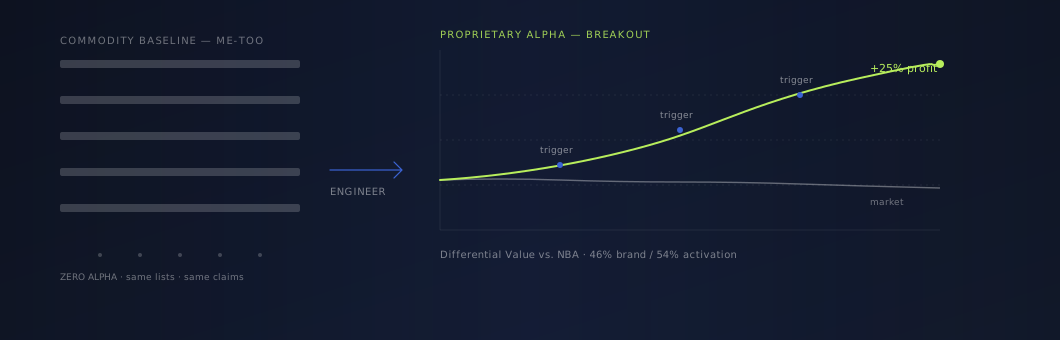
Differentiation is a financial term, not a creative one. It's the excess return — the alpha — that compounds when your engine produces signals competitors can't buy.
Five engineered escapes
- Identity Alpha: reject Marketing-Mary personas and engineer Concrete Customer Lists with real-time triggers — proprietary by construction.
- Mental Availability: seed the 95% out-of-market with a B2B-tuned 46% brand / 54% activation split.
- NBA Math: compute Differential Value vs. the Next Best Alternative, minus switching costs. Sell payback periods, not features.
- Pricing Power: 10% price → 25% profit. Run Willingness-to-Pay conversations before product, and use the Magic of the Middle to anchor margin.
- Trigger Physics: reach buyers in the Window of Dissatisfaction — 74% more likely to win — instead of the RFP.
What is "differentiation alpha"?
Differentiation alpha is the excess return — borrowed from the financial sense of "alpha" — that a brand earns over the commoditized market baseline when its targeting, value math, and timing are engineered rather than improvised. It is the gap between the flat performance of "me-too" competitors and the breakout curve of a brand whose proprietary signals, pricing power, and trigger detection compound into outsized share. Alpha cannot be bought from a data vendor; it must be engineered.
In this article we also define: Proprietary Alpha · Differential Value & the Next Best Alternative · Magic of the Middle · Window of Dissatisfaction · Perception-Reality Gap.
No. 01 The death of the "me-too" brand.
When your targeting comes from the same broker as your competitor's, your message borrows the same templates as your category, and your timing reacts to the same RFPs — you are by definition a commodity. The market clears commodities at the lowest price. Your gross margin compresses. Your differentiation decays.
This is the Me-Too Tax: the silent cost of using the same inputs as your competitors and expecting different outcomes.
If your objective product data contradicts customer sentiment, you have a Perception-Reality Gap. Use the 2×2:
- High Traffic / Low Conversion: a messaging failure — you're failing to communicate the math of your value.
- Low Traffic / High Conversion: an acquisition failure — value lands, but the engine is broken.
No. 02 Identity engineering: reject the Marketing-Mary tax.
Traditional B2B targeting is built on the fallacy of the buyer persona. As critics like Sam Grover have noted, these "Pointless Personas" focus on demographic noise — age, gender, hobbies — that's statistically irrelevant to B2B purchasing.
True differentiation requires Identity Engineering. Move from the hypothetical to the concrete customer list. In the post-data-provider era, relying on commoditized brokers like ZoomInfo isn't a strategy — it's a tax. If your competitor can buy the same list for $50K, your targeting provides zero alpha.
| Feature | Theoretical personas | GTM-engineered concrete lists |
|---|---|---|
| Data source | Demographic guesswork | Real-time web signals + technographics |
| Freshness | Static / fictional | High — real-time triggers |
| Exclusivity | Zero — generic archetypes | High — Proprietary Alpha |
| Mechanism | Manual guesswork | AI agents (e.g., Claygent) |
By using AI agents and Waterfall Enrichment (querying multiple providers in sequence), you create Proprietary Alpha. We don't target "Dentists." We target "Dentists in New York who feature Invisalign on their homepage but have a broken booking link." That dataset can't be bought. It has to be engineered.
No. 03 The 95:5 rule: the strategy of mental availability.
Research from the LinkedIn B2B Institute confirms a brutal market truth: at any given moment, only 5% of your buyers are in-market. The remaining 95% aren't ready to buy today.
Most marketers suffer from a Now Obsession, fighting for the 5% in a Red Ocean of high-cost PPC and lead gen. Real differentiation requires seeding the 95% — building Mental Availability and linking your brand to specific Category Entry Points (CEPs) long before a search begins.
Reject the general 60/40 brand-to-activation heuristic. In the complex B2B sales cycle, the data-driven precision of the Rubikn Growth Architecture optimizes at a 46% Brand / 54% Activation split. Enough fame to be the preferred choice the moment the 95% transition into a buying state.
No. 04 Differentiation is a math problem: the Next Best Alternative.
Value is never absolute. It's relative to the customer's Next Best Alternative (NBA). If you can't calculate your Differential Value, your sales team is guessing at the gap.
The formula:
Differential Value = (Client Benefit − Competitor Benefit) − Switching Costs
Consider an industrial lighting solution:
- Client benefit: saves $10,000/yr in energy
- Competitor benefit: saves $8,000/yr
- Differential value: $2,000/yr
- Switching cost: $5,000 (installation, downtime)
- Payback period: 2.5 years ($5,000 / $2,000)
If you sell features instead of financial outcomes like a 2.5-year payback, you're a commodity. The math survives a board meeting. Feature lists don't.
No. 05 Pricing power: the ultimate economic lever.
Price is the only element of the marketing mix that generates revenue; all others generate costs. Within Profit = (Price − Cost) × Quantity, price is your most potent lever:
- A 10% increase in volume yields a 10% profit gain.
- A 10% increase in price yields a 25% profit gain.
Counter-intuitively, differentiation does not happen after the product is built. Following the 9-Step Monetization Discipline, Willingness to Pay (WTP) conversations must happen before product development. Design around the price point the market rewards. Don't justify the cost of your engineering after the fact.
Structure your tiers so the "Best" option anchors value and makes the "Better" option — where you've strategically hidden your highest margins — the obvious choice for the buyer. Three tiers, never two. The middle is where the alpha lives.
No. 06 Trigger Event Physics: the Window of Dissatisfaction.
Timing is a physical dimension of GTM success. Buyers oscillate between the status quo and the Window of Dissatisfaction. Once they move into "Searching for Alternatives," you've already lost.
Vendors who reach decision-makers before they search are 74% more likely to win. If you're responding to an RFP, you're fulfilling requirements defined by the competitor who got there first.
- The Past Customer Play: when a champion moves to a new company, they're 3× more likely to buy again. This is an automated trigger, not manual outreach.
- Technographic shifts: detecting the removal of a competitor's software tag signals a churn event — the precise moment to launch a displacement campaign.
The decay of differentiation
Differentiation is subject to rapid decay. History teaches us this through Reebok's 1980s "picnic strategy" — succeeding by identifying that people wore athletic shoes for casual use. When the market shifted toward casual brown shoes, Reebok's failure to maintain continuous Exploratory Market Research turned its greatest insight into an outdated liability.
Complacency is the mother of commodity. Defensible differentiation requires a cyclical commitment to EMR — to detect motivational shifts before they become catastrophic sales declines.
Is your current messaging based on a market truth from last year — or a real-time signal from this morning?
Sources & further reading
- Dawes, J. Advertising Effectiveness and the 95-5 Rule. LinkedIn B2B Institute / Ehrenberg-Bass Institute.
- Marn, M. V., & Rosiello, R. L. (1992). Managing Price, Gaining Profit. Harvard Business Review.
- Simon, H. (2015). Confessions of the Pricing Man. Springer.
- Grover, S. Pointless Personas. (Industry critique of B2B persona design.)
- Elias, C. Trigger Event Selling. SHiFT Selling.